AI and software together give us an amazing opportunity to better understand the patient experience through support channels.
Too Many Systems, Not Enough Visibility
Put simply, health tech companies have long struggled to gather insight from their support operations because of too many systems, limited integrations, and compliance requirements that make it harder to connect them. Often the EHR functions as the CRM. Even when it doesn't, the CRM is rarely designed with healthcare operations in mind. Add provider portals, scheduling tools, and a CCaaS platform on top, and the picture gets even more fragmented.
The convergence of all these systems inside the support org presents a unique opportunity, and AI finally gives us the tools to capitalize on it.
What you can see here is an example. The combination of AI quality assurance, contact dispositioning, keyword collection, sentiment, and quantitative metrics allows us to understand what's actually happening with the product, the service experience, and the efficacy of the support org in supporting outcomes.
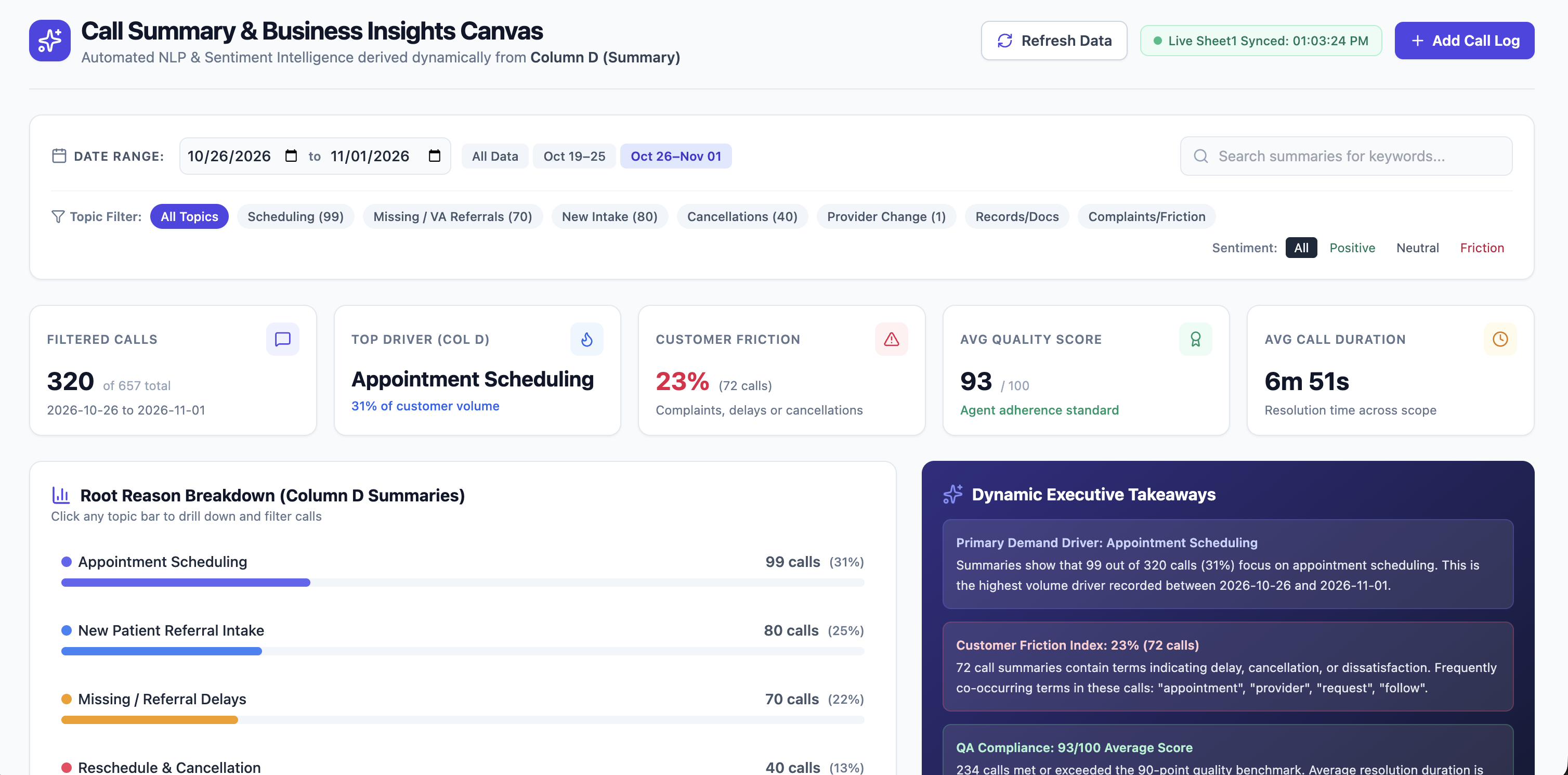
What AI Changes
It all starts with the ability to work from a dataset that's free of PHI. From there, AI lets us skip the integrations and APIs that used to be required, and just look at things like who is saying what, and how many times.
That means we can immediately see:
- What's causing patients to contact us in the first place? Root reason and keyword tagging.
- How impactful is it to the patient? Sentiment.
- Is support able to solve the problem? Quality assurance.
- Can this be fixed at the product level? Individual contact summaries, and transcripts when needed.
What We've Seen Since Rolling This Out
We've rolled this approach out across every project and immediately seen the impact. Managers have a stronger handle on who's doing well and what individual team members can improve on, and teams have been able to move QA scores well into the 90s.
On the client side, operators can bring thorough, data-backed breakdowns into their conversations with product, finance, and engineering about the real impact of features and policy changes.
Isn't This Already in My CRM?
Every operator asks some version of this question, and the honest answer is: not really. Productized SaaS simply isn't built to do this. Is it scalable the way an off-the-shelf tool is? Not really either — which is exactly the opportunity.
Support is a material investment every company makes. It deserves a custom solution, and a custom solution is only possible when you can unify any combination of outputs from any combination of tech stack components in a compliant way.
The foundation is your CCaaS, EHR, and supporting tools that can strip PHI and surface raw data. But the custom analytics layer that sits on top of that foundation is something only an operator or forward-deployed engineer can really build — and most FDEs don't have the incentive to support the efficacy of tools they don't own.
What This Means for Healthcare Operators
This is the kind of thing that gets me excited about the future of support. If you want to make educated decisions about what to automate, where humans add the most value, and what product or service changes to prioritize, make sure your contact center is reporting on exactly what matters for your business.