Compliance with the Health Insurance Portability and Accountability Act, usually referred to as HIPAA, is essential for any healthcare support operation. The requirements around privacy, security, and breach notification can be a major investment, both in terms of technology as well as process and time spent by the team.
However, the right tech stack can save a ton of time and money when deployed correctly, while maintaining a secure and audit-ready support environment that secures Protected Health Information (PHI).
First, where can you find the requirements of HIPAA?
The source material for HIPAA regulations is in the Code of Federal Regulations (CFR) Title 45, Subtitle A, Subchapter C, Parts 160, 162, and 164.
The only way to be truly certain your operation is HIPAA compliant is to check the requirements of the federal regulations against your technical and operational components. We use - and recommend our clients use - a checklist that matches policy and technical components with the requisite regulation.
What are the key technology components for HIPAA compliant customer support?
Each component below maps to a specific part of the federal regulation. Click a card to see the exact citation.
Identity and access
A database that identifies every user, only grants access after verification, and controls the amount of access they have to systems.
View regulation reference
Data protection
Tools that prevent destroying, exporting, or changing protected PHI.
View regulation reference
Endpoint and device security
Antivirus and security software for laptops, computers, or other endpoints.
View regulation reference
Monitoring and audit
Today: Purview Audit (Premium). With Island: Island audit plus endpoint logs. In both cases logs are reviewed on a schedule and kept six years.
Tools that track and monitor access to PHI, including actions taken by users such as downloading or printing. Includes a requirement to maintain auditable records for 6 years.
View regulation reference
What are the key process components for HIPAA compliant customer support?
Assess and govern risk
Documented process to determining what risks are, how they are handled, and whether they happened in a given period.
View regulation reference
Control who has access
Follow the minimum-necessary standard, only allowing access to PHI as required for the duties of the job.
View regulation reference
Train people and build the culture
Train regularly on security, the importance of compliance, and the critical nature of reporting incidents.
View regulation reference
Respond to incidents and plan for disruption
Report incidents as required. Build Business Continuity Plans and test them regularly.
View regulation reference
Maintain BAAs
Ensure associated parties have signed a Business Associate Agreement and the terms are codified in process.
View regulation reference
Comparing the Two Stacks
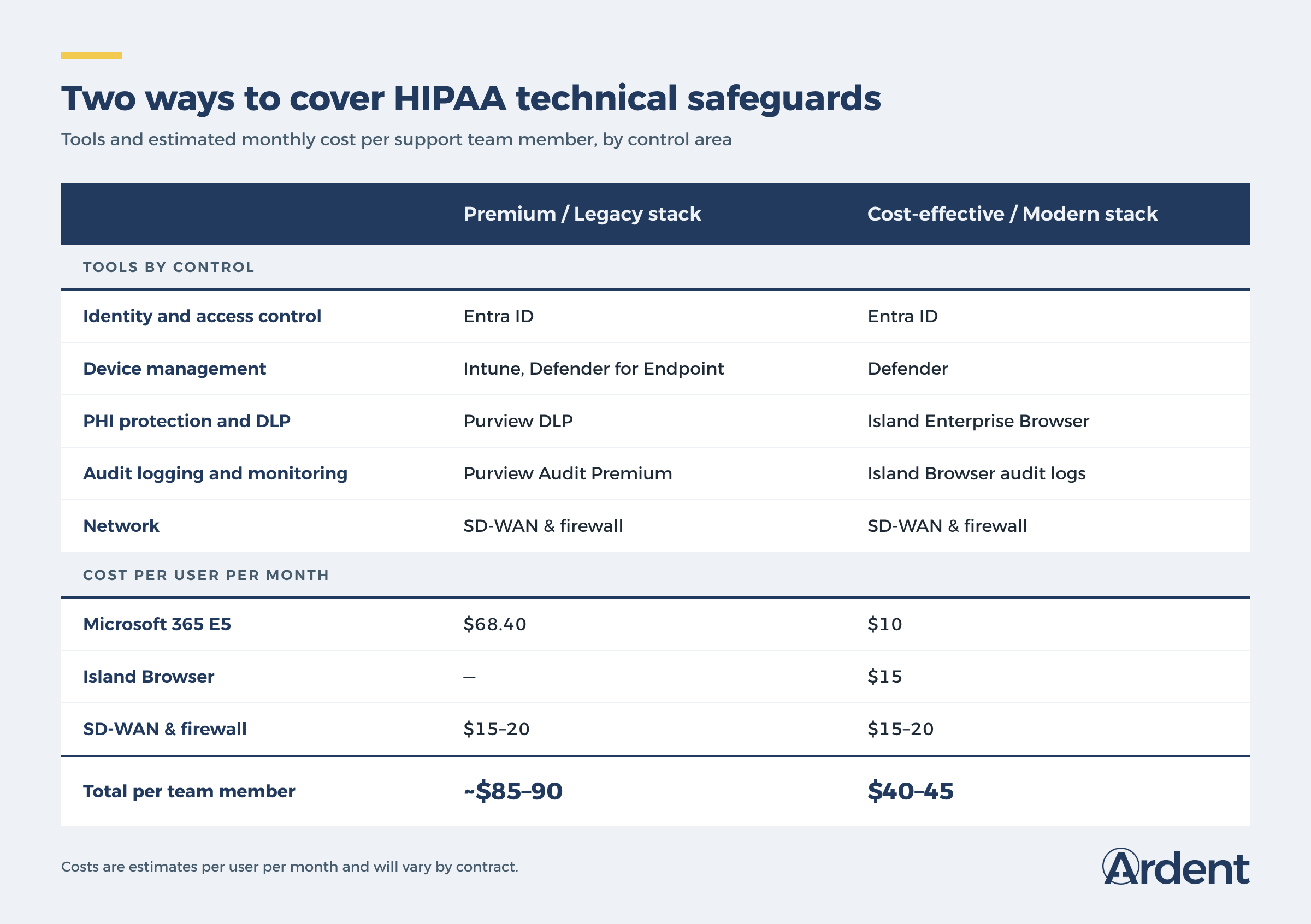
So you've got a HIPAA compliant plan. You've assigned owners, written policies, and are ready to execute on the process side of things. But what about tech? You have a couple options at different price points that get you the rest of the way.
Are there any added benefits of the modern tech stack?
For us, absolutely. We're an outsourcing company whose clients use a wide range of systems. Using a secure browser as a critical component of our tech stack lets us onboard faster, access any tool that can be accessed via Chrome, reduce hardware spend, and even support BYOD or remote contractors as needed, while still meeting the requirements of our BAAs, contracts, and HIPAA.
Overall, finding the right modern tech stack can reduce costs by half and make it so operations teams can operate as true partners of their CISOs and InfoSec teams when it comes to ensuring operational success and HIPAA compliance.